
EU – UK Qualifications Framework
As a European Institution, EBMAC officially follows the European Qualification Framework (EQF) , UK Regulatory Qualifications Framework – RQF, and MQF – Malta Qualifications Framework:
The Malta Qualifications Framework (MQF) is a system for categorizing qualifications in Malta based on learning outcomes like knowledge, skills, and competencies. It aims to make Maltese qualifications transparent and comparable to those in other countries by referencing the European Qualifications Framework (EQF). There are eight MQF levels, ranging from Level 1 (school-leaving certificate) to Level 8 (doctorate), which include both academic and vocational qualifications. 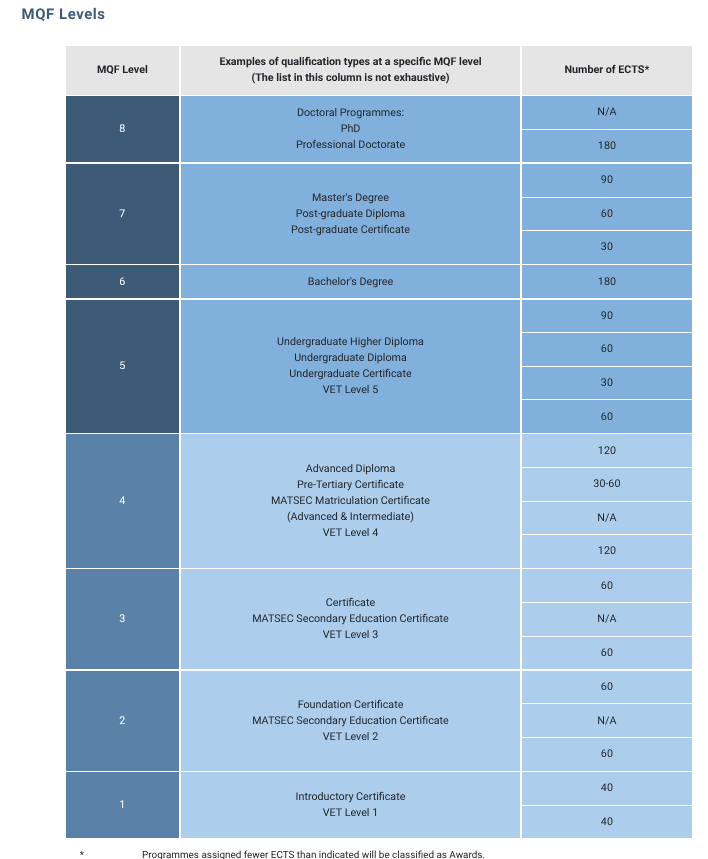
United Kingdom (UK) Regulated Qualifications Framework (RQF)
The Qualifications and Credit Framework (QCF) was in operation between 2008 and 2015. Since 2015, the Regulated Qualifications Framework (RQF) replaced the Qualifications and Credit Framework and is in use in England, Wales and Northern Ireland.
The RQF framework has nine levels from Entry Level through to Level 8, with Level 8 being the highest. The level of a qualification shows how difficult the learning is.
Qualifications that share the same level:
- are broadly similar in terms of the demand
- can be very different in terms of content, duration and assessment method.
For example, GCE A levels are at level 3 on the RQF, as are BTEC Level 3 National qualifications and the Level 3 Extended Project qualification. The level of the qualification is stated in the qualification title to ensure it’s really clear for users of the qualification.
How is the size of the qualification determined?
Qualifications on the RQF have their size expressed in terms of Total Qualification Time (TQT) and, where appropriate, Guided Learning (GL) and credit.
TQT is, essentially, the total number of hours a learner is expected to take to complete the qualification to the required standard. It includes:
- Guided Learning, where a learner is being taught by a tutor or is otherwise participating in training under the immediate guidance or supervision of a tutor. This includes assessment activity undertaken under the immediate guidance or supervision of a tutor/assessor
- an estimate of the number of hours a learner will reasonably be likely to spend in preparation, study or other form of participation in training, including assessment, that is not under the immediate guidance or supervision of a tutor.
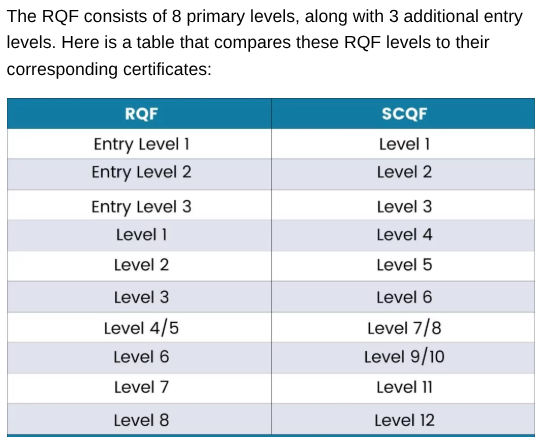
How do RQF levels compare with other qualification frameworks?
The European Qualifications Framework (EQF):
The EU developed the European Qualifications Framework (EQF) as a translation tool to make national qualifications easier to understand and more comparable. The EQF seeks to support cross-border mobility of learners and workers, promote lifelong learning and professional development across Europe.

The EQF is an 8-level, learning outcomes-based framework for all types of qualifications that serves as a translation tool between different national qualifications frameworks. This framework helps improve transparency, comparability and portability of people’s qualifications and makes it possible to compare qualifications from different countries and institutions.
Regarding the EQF 8 Levels, for a better knowledge and clear understanding you may visit this link: https://europass.europa.eu/en/description-eight-eqf-levels
EQF, where The learning outcomes are defined in terms of:
Knowledge: in the context of EQF, knowledge is described as theoretical and/or factual.
Skills: In the context of EQF, skills are described as cognitive (involving the use of logical, intuitive and creative thinking) and practical (involving manual dexterity and the use of methods, materials, tools and instruments).
Responsibility and autonomy: In the context of the EQF responsibility and autonomy is described as the ability of the learner to apply knowledge and skills autonomously and with responsibility.
The EQF covers all types and all levels of qualifications and the use of learning outcomes makes it clear what a person knows, understands and is able to do. The level increases according to the level of proficiency, level 1 is the lowest and 8 the highest level. Most importantly the EQF is closely linked to national qualifications frameworks, this way it can provide a comprehensive map of all types and levels of qualifications in Europe, which are increasingly accessible through qualification databases.
The EQF was set up in 2008 and later revised in 2017. Its revision has kept the core objectives of creating transparency and mutual trust in the landscape of qualifications in Europe. Member States committed themselves to further develop the EQF and make it more effective in facilitating the understanding of national, international and third-country qualifications by employers, workers and learners.
The EQF works together with other European and international instruments supporting the recognition of qualifications.
- The Council Recommendation of 26 November 2018 on promoting automatic mutual recognition of higher education and upper secondary education and training qualifications and the outcomes of learning periods abroad refers to the EQF as a way to foster transparency and build trust between national education and training systems
- Directive 2005/36/EC addresses the recognition of professional qualifications in the EU, enabling professionals to move across borders and practise their occupation or provide services abroad
- The Lisbon recognition convention is an international agreement administered by UNESCO and the Council of Europe that allows for the recognition of academic qualifications in Europe and beyond;
- The EQF is compatible with the Qualifications Framework for the European Higher Education Area and its cycle descriptors. The framework was agreed by education ministers of the intergovernmental Bologna Process in 2005.
Source: https://europass.europa.eu/en/europass-digital-tools/european-qualifications-framework